



Something happened in Turkey's immigration system this week that has no precedent in 15 years of monitoring it.
On April 29, 2026, the Turkish government implemented a sweeping overhaul of residence permit fees — raising the Harç (residence permit tax) by as much as 930% for most nationalities. The new rates were not rumoured. They were living inside the e-ikamet portal. Tax offices were collecting them. Applicants attending appointments that day paid the new amounts in full and walked out with receipts.
Less than 24 hours later, the Presidency of Migration Management issued a formal statement. The fees were restored to their previous levels. And buried in that statement was something that had never appeared before in the history of Turkey's residence permit system: an explicit end-date on the fee schedule — January 1, 2027.
This article is the complete record. What were the fees on April 29? What they are today. Who paid the difference? And what January 2027 actually signals.
First: The Good News
The fees are reversed. If you are applying for a Turkish residence permit today — whether you are a British retiree in Bodrum, an American digital nomad in Istanbul, a Russian expat in Antalya, or an investor anywhere in the country — the rates in effect are the same rates that have governed applications since 2011.
For the first time, those rates carry a government-confirmed end-date: valid until January 1, 2027.
Apply now. Apply correctly. The window is confirmed and guaranteed in writing for the first time in the history of this policy.
What You Pay Today: The Complete Fee Structure
Turkey's residence permit cost is built from two entirely separate government charges. Understanding the difference matters — they are governed by different laws, paid via different mechanisms, and change on different schedules.
The Belge Bedeli — ₺964, everyone, no exceptions
The document fee under Law No. 210. Charged to every applicant for the physical residence permit card. Set annually by the Ministry of Finance each December. No nationality exemptions exist. It was ₺964 before April 29. It is ₺964 today.
The Harç — varies by nationality, priced in USD
The residence permit tax under Law No. 492. Calculated by the Ministry of Treasury and Finance based on the principle of reciprocity — what your country charges Turkish citizens broadly determines what Turkey charges you. Structured into five nationality tiers. This is the fee that changed on April 29 and was restored on April 30.
The five current tiers, converted to TL at the prevailing exchange rate on the day of payment:
| Group | First Month | Each Month After | Key Nationalities |
|---|---|---|---|
| 1 | $25 USD | $5 USD | USA, UK, Germany, Australia, Canada, France, Italy, India, China, Ukraine, Kazakhstan, Brazil, Netherlands, Sweden, Switzerland, and 130+ others |
| 2 | $14 USD | $3.50 USD | Albania, Philippines, Israel, Japan, Cambodia, North Macedonia, Mali, Tajikistan, Oman |
| 3 | $9 USD | $2.50 USD | Belgium, Belarus, Algeria, Spain, Kuwait, Luxembourg, Malta, Singapore, Taiwan, Jordan |
| 4 | $7 USD | $1.50 USD | Ethiopia, South Korea, Hong Kong, Micronesia, Russia |
| 5 | $5 USD | $0.50 USD | Morocco, Ivory Coast, Iraq, Montenegro, Egypt, Tunisia |
Outside all groups — Serbia, Fiji, Norway, and Northern Mariana Islands: ₺348.10 per day for the first month (minimum ₺653.70, maximum ₺3,359.90), then ₺2,232.30 per subsequent month.
These USD amounts have been unchanged for more than a decade. Fifteen years of stability — until April 29.
Who pays only the ₺964 Belge Bedeli — Harç exempt
Under Article 88 of Law No. 492, the following categories pay no Harç:
By nationality (reciprocity principle): Czech Republic, Denmark, Ireland, Kosovo, Nepal, Sri Lanka, Syria, Turkmenistan, Northern Cyprus (KKTC), Palestine.
By category, any nationality: students enrolled in Turkish university degree programmes (TOMER language course students are not exempt); Turkish-origin foreign nationals (Türk soylular); long-term permanent residence permit holders renewing; victims of human trafficking.
What Was Live on April 29 — Primary Source Evidence
The following are taken directly from the Turkish government's e-ikamet system. Applicant reference numbers have been redacted for privacy. The figures speak for themselves.
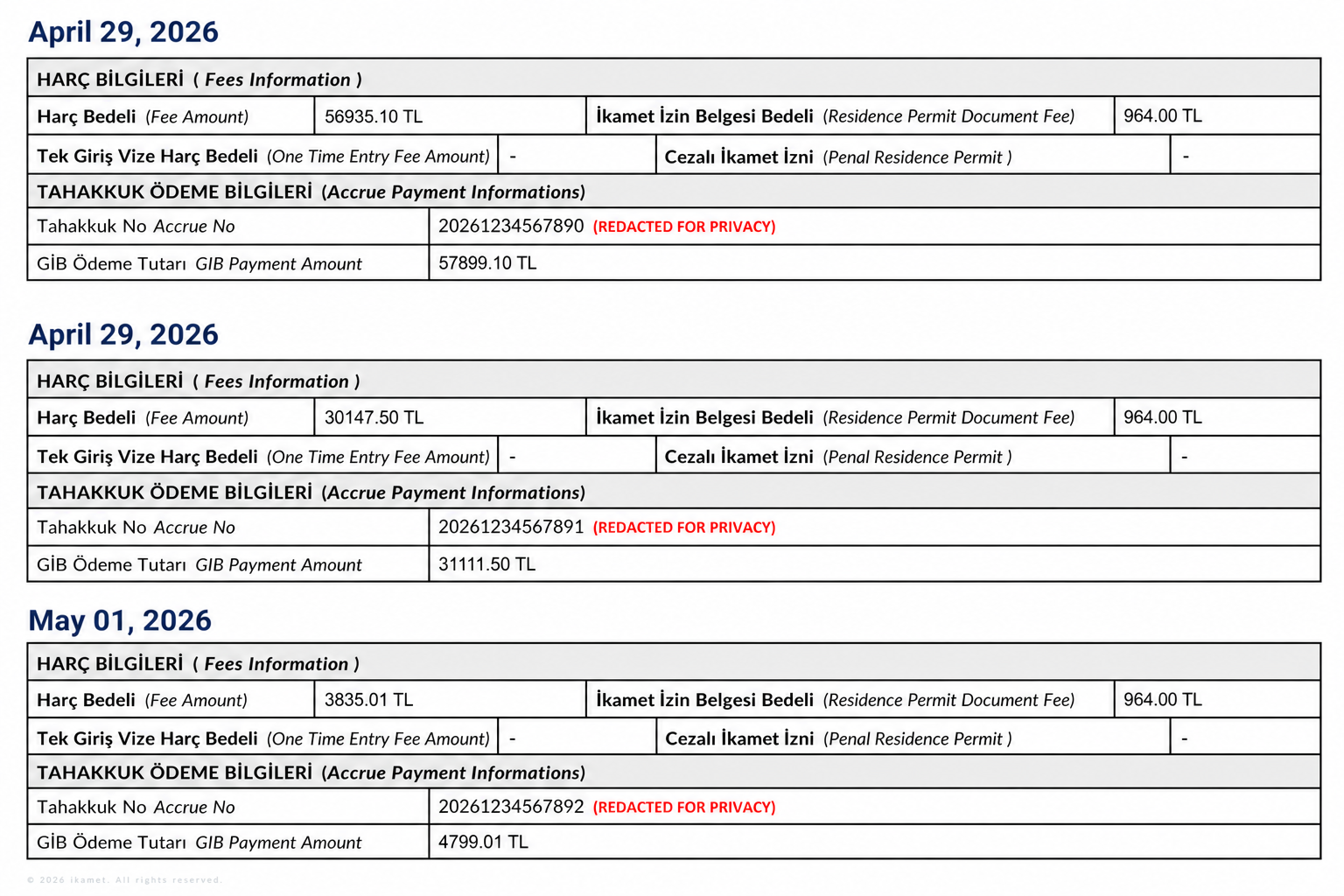
The reversal is not an interpretation. It is visible in the government's own system output, 24 hours apart, on the same screen.
The April 29 formula that produced these figures applied a single flat TL rate uniformly, replacing the entire USD-based nationality tier system that had existed since 2011. A Russian national went from approximately $7 for a first month to facing ₺57,899.10 for a two-year permit. An American went from roughly $25 to the same figure. The reciprocity principle — the entire foundation of the fee structure since 2011 — was erased in a single system update.
Who Felt It — and How Fast
The reaction was immediate, coordinated, and reached the right people within hours.
Citizenship-by-investment applicants were hardest hit in terms of raw shock. Investors committing €400,000 to Turkish real estate for a pathway to citizenship were suddenly facing permit fees approaching the administrative cost of the passport itself. These applicants have retained legal counsel and institutional advisors. They do not sit quietly.
Foreign spouses of Turkish citizens had no exemption under the April 29 structure. A three-year family permit would have cost ₺84,686.70 in government fees alone — a sum entirely disconnected from the household budgets of most mixed families living ordinary lives in Turkey. Immigration law specialists flagged this as disproportionate within the same working day.
Mid-process applicants who attended appointments on April 29 paid the new amounts under a legally valid instrument at the time of collection. The reversal does not include an automatic refund mechanism. This is the outstanding human question from the 24-hour episode — real people, real receipts, real money paid in good faith — and it has not been formally addressed. We are pursuing this and will update when there is clarity.
The broader expat and legal community across forums, Telegram groups, and professional networks reacted at a speed that matched the scale of the shock. International coverage confirmed that the figures were being verified by lawyers and intermediaries as applicants came out of tax offices with receipts — before the numbers disappeared from the official website just as quickly as they had appeared.
What the Government Actually Said
The Presidency of Migration Management published a statement on April 30 under the heading "About Residence Permit Fee Amounts." The full official response is below.
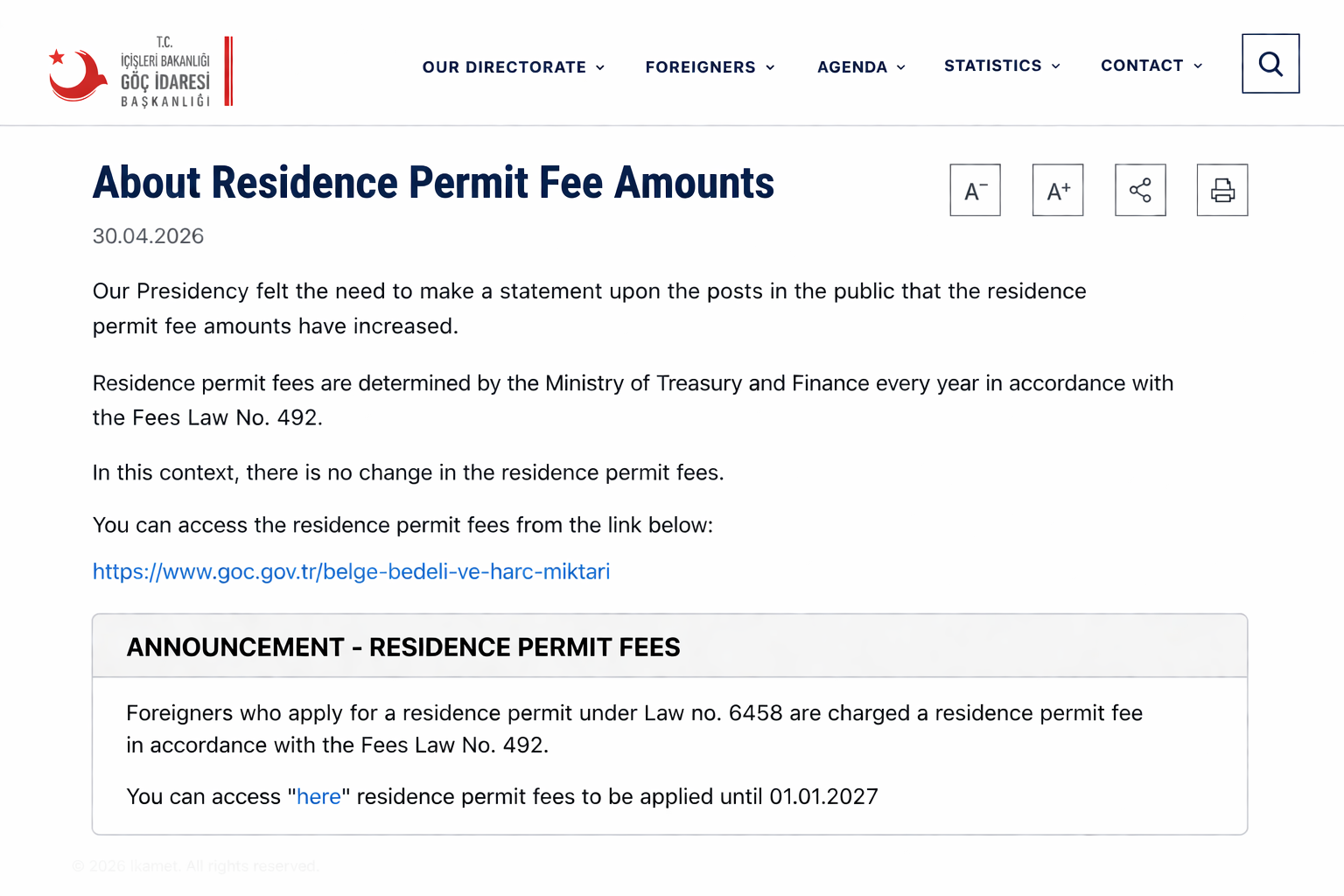
"In this context, there is no change in the residence permit fees." — Presidency of Migration Management, 30.04.2026
It did not use the word reversal. It did not acknowledge that elevated rates had been live and collected for 24 hours. It did not address applicants who paid the higher amounts.
What the statement did produce — via the fee schedule page it pointed to — was an end-date that has never appeared before: valid until January 1, 2027.
The January 2027 Signal: Two Readings, One Conclusion
Since 2011, Turkey's nationality-group Harç amounts have never carried a published expiry date. They simply were what they were — updated when updated, with no advance notice and no formal commitment to stability.
That changed on April 30, 2026.
Reading one — coming back, properly this time. The April 29 implementation may have been a genuine policy that arrived before its political groundwork was complete. The public reaction was faster and more organised than anticipated. The January 2027 date may represent a properly sequenced relaunch: the same structural overhaul, with the communications infrastructure and regulatory preparation that April 29 lacked.
Reading two — a stabilisation signal. Facing widespread alarm, the government may have published an explicit end-date specifically to communicate: nothing changes before January. The rates are locked. This interprets the date not as a warning but as a guarantee — the most formal assurance of fee stability the Turkish government has ever issued in this domain.
Both readings lead to the same practical conclusion. The current window is confirmed. What replaces it in January 2027 is not yet public. What is public — for the first time — is when the window closes.
How Turkey Compares Globally
For context on what the April 29 rates would have meant: Hungary charges €60–€210 per year for a standard temporary residence permit. Portugal €160–€255. Italy €100–€160. Spain €11–€410 depending on category.
At the April 29 rates, Turkey's one-year permit would have cost approximately $631 — double or triple most European equivalents. The three-year total of approximately $1,857 would have placed Turkey at the top of the global range.
At current restored rates, a US or UK national pays roughly $80–$90 equivalent for a full year's Harç, plus ₺964 Belge Bedeli. Turkey remains among the most cost-effective places in the world to hold legal long-term residency.
Frequently Asked Questions
What are the current Turkey residence permit fees in 2026?
The Belge Bedeli is ₺964 for all nationalities without exception. The Harç is determined by nationality group in USD, converted to TL at the day's exchange rate on payment. Most Western nationals fall into Group 1: $25 first month, $5 per subsequent month. Confirmed valid until January 1, 2027.
Did Turkey increase residence permit fees in 2026?
Yes — briefly. On April 29, 2026, a new structure went live raising costs by up to 930% for most nationalities. It was reversed within 24 hours. The previous structure, unchanged since 2011, was restored on April 30.
Are the higher fees coming back?
Current rates are confirmed until January 1, 2027. The publication of this explicit end-date — unprecedented in 15 years — signals a revised structure is being prepared for that date. No changes are expected before then.
How much is the Turkey residence permit fee for UK citizens in 2026?
UK nationals are in Group 1: $25 USD first month, $5 USD per subsequent month, converted to TL at the day's rate, plus ₺964 Belge Bedeli flat.
How much is the Turkey residence permit fee for US citizens in 2026?
Identical to UK nationals. Group 1 rates apply: $25 first month, $5 per month thereafter, plus ₺964 Belge Bedeli.
How much is the Turkey residence permit fee for Russian citizens in 2026?
Russian nationals are in Group 4: $7 first month, $1.50 per subsequent month, converted to TL, plus ₺964 Belge Bedeli.
Who is exempt from Turkey residence permit Harç?
Nationals of Czech Republic, Denmark, Ireland, Kosovo, Nepal, Sri Lanka, Syria, Turkmenistan, Northern Cyprus, and Palestine. Also exempt regardless of nationality: university degree students, Turkish-origin nationals, long-term permit renewers, and trafficking victims.
What if I paid the higher fees on April 29?
You paid under a legally valid instrument at the time of collection. There is no confirmed automatic refund mechanism. We are pursuing formal clarity and will publish an update when we have an answer. Retain all receipts and your tahakkuk reference number.
When should I apply for a Turkey residence permit?
Now. The fee structure is confirmed until January 2027. Waiting introduces uncertainty that does not currently exist.
The Unanswered Question
Some applicants did everything correctly on April 29. They attended their appointments. They paid what the system required at that moment. The system was correct under the legally published instrument then in force.
Those applicants are now holding receipts that no one else will ever hold. Whether any formal recourse exists — whether the government has any obligation to address applicants caught in the 24-hour window — is a question that deserves a public answer.
We are asking it formally. We will publish what we find.

Member discussion